Unified data estate for the agentic AI era
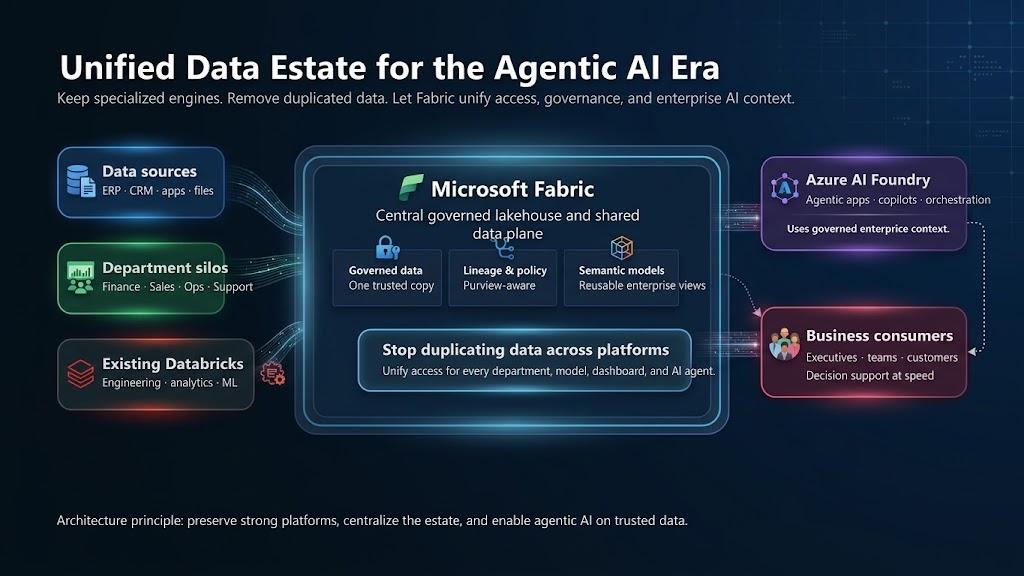
Most enterprises already have serious investment in data platforms, and in many organizations Databricks is a key part of that foundation.
That investment should not be thrown away. The real architectural question is whether the enterprise can move from a collection of platform-specific data copies to a unified data estate that can safely serve analytics, ML, and agentic AI.
That is the direction Microsoft’s Fabric guidance points toward: preserve specialized engines, but centralize the governed data plane so teams do not keep duplicating the same data across every workload, department, and AI initiative.
The problem is not lack of data
Most large organizations do not have a shortage of data. They have a coordination problem.
Data is often spread across:
- engineering pipelines
- analytics workspaces
- ML feature stores
- departmental datasets
- AI-specific application stores
- reporting extracts and shadow copies
Each copy adds cost, latency, and governance overhead. It also creates a harder question for leaders: which version is authoritative?
If an organization is serious about GenAI and agentic apps, that fragmentation becomes a material constraint. AI systems need broad access to enterprise context, but they also need governed access, lineage, policy, and trust.
Keep specialized engines where they are strong
This is not a binary choice between Databricks and Fabric. That framing is too simplistic.
Databricks remains a strong choice for:
- data engineering
- large-scale transformation
- analytics workloads
- ML experimentation and training
- teams that already depend on that platform
The point is not to replace a working engine. The point is to stop using every engine as a separate copy of the enterprise truth.
Specialized platforms can continue to do what they do best while the enterprise standardizes the shared estate above them.
Why Fabric matters
Microsoft Fabric becomes strategically useful when the enterprise wants one governed place for data access, semantic reuse, and policy enforcement.
In the architecture view, Fabric can act as a central governed lakehouse and shared data plane.
That matters because it gives architects a way to:
- reduce duplicate data movement
- standardize lineage and policy
- expose reusable semantic models
- simplify access across departments
- provide a cleaner foundation for AI apps and copilots
In practical terms, Fabric is less about another tool and more about a data operating model.
The architectural benefit is straightforward: if data is governed once and consumed many times, you reduce the cost of every downstream application.
Why this matters for agentic AI
Agentic AI changes the conversation.
Traditional analytics mainly asks, how do I report on the data we already have?
Agentic AI asks, how do I let software reason across trusted enterprise context and take action safely?
That requires:
- governed access to business data
- lineage and policy controls
- shared semantics instead of one-off extracts
- lower duplication across AI projects
If every AI app builds its own local data copy, the organization ends up with fragmented intelligence. If every department maintains a separate dataset for its own agent, the enterprise inherits the same silos it was trying to eliminate.
A unified estate gives Azure AI Foundry and similar agentic platforms a better foundation to operate on.
The architecture pattern I recommend
For lead architects and strategic leaders, the best model is not “move everything to one place.” It is:
- Preserve strong platforms where they already work.
- Centralize the enterprise data estate so governance and semantics are shared.
- Expose data through trusted, reusable views instead of duplicating it repeatedly.
- Build agentic AI on top of governed context rather than project-local copies.
- Keep the operating model simple enough to scale across departments.
That pattern is better than a platform sprawl strategy because it reduces operational drag. It also gives leadership a clearer answer when new AI initiatives arrive: where does the trusted context live, and who governs it?
What executives should care about
This is not just an architecture preference. It is a portfolio decision.
The organizations that will move fastest in the AI era will not be the ones with the most platforms. They will be the ones with:
- fewer redundant copies
- clearer ownership
- stronger governance
- more reusable semantics
- a faster path from data to AI value
That is why the image matters: the left side shows the reality of fragmented sources and existing investments, the center shows the governed estate, and the right side shows the AI and business consumption layer.
The message is simple: preserve what is already strong, unify what should be shared, and avoid duplicating the enterprise truth just to power the next AI app.
Final thought
Databricks is still important. Fabric is increasingly relevant. Azure AI Foundry accelerates the agentic layer.
The right strategy is not to force a false choice between them. It is to align them into a coherent enterprise intelligence architecture.
If your organization is planning for GenAI or agentic AI at scale, the first question should not be which platform to standardize on. It should be how quickly you can build a unified data estate that keeps specialized engines intact while giving AI trusted access to enterprise context.